

Blog
Archive for the "Head of School" Category
Lessons Learned from Middle Schoolers
May 06, 2026
Lessons Learned from Middle Schoolers
By Dr. Kerri Miner, Head of School
Any parent or teacher will tell you that middle schoolers are simultaneously difficult and wonderful. I experienced this firsthand not only when my own four children were middle school-aged, but also when I taught sixth grade at CCAC.
One class was particularly cranky one day and seemed to grumble and complain about every activity. Finally, I’d had enough. I said to the students, “Look, kids. I work hard to try to make learning fun for you all. But I get paid the same if I just make you read the textbook and take notes all day. Which would you prefer?”
The most notable response was from a student who said, “Wait, you get PAID?”
I was taken aback. Of course educators get paid. Not much, but we get paid. The point was, there was no stipulation in my contract stating I had to work extra hours to make the activities fun and enjoyable for students. But that wasn’t the lesson they learned that day.
Isn’t it just like a middle schooler to assume a teacher is there as a volunteer, working with students out of the goodness of her heart, but for the middle schooler to grumble and complain anyway?
For that matter, doesn’t this sound an awful lot like all of us? We tend to forget that behind many of life’s greatest blessings is a person who is doing more than is required of him or her. The Bible addresses this type of attitude directly:
“Do everything without grumbling or arguing, so that you may become blameless and pure, children of God without fault in a warped and crooked generation. Then you will shine among them like stars in the sky” (Philippians 2:14–15).
Grumbling is easy. Gratitude requires effort and intention.
That day in my classroom, I could have shifted to textbook reading and note-taking. But the real lesson wasn’t about instructional methods. It was about attitudes.
What if, instead of asking, “Why can’t this be easier?” or “Why can’t I have my way?” we began asking, “What can I find to be grateful for today?”
Middle schoolers often reveal something that holds true for the rest of us. Maybe that’s the gift in teaching them: not just shaping their hearts, but allowing the Lord to refine our own hearts through them.
When we trade grumbling for positivity, everything changes; not the circumstances, but the way we perceive them. After all, none of our circumstances compare to those of the blameless Jesus on the cross.
Facing the worst misery any of us could imagine, did He argue or complain? No. Instead, Jesus forgave and saved the thief next to him, asked God to forgive those who were tormenting Him, and affirmed His spirit was committed into God’s hands. What an example to follow.
I am very grateful for the years I got to teach middle schoolers. Those few years were a highlight of my career. I loved my students (and they sometimes loved me back). More than that, though, I learned a lot in those years about my own attitude and how I am perceived by others. I learned that grumbling and arguing reveal more about our own hearts than about our circumstances. Having a positive attitude, on the other hand, can reshape both.
Posted in
Head of School
SHARKS!
March 04, 2026
A few years ago, when my husband and I celebrated our 25th wedding anniversary, we took a bucket-list trip to Eleuthera Island in the Bahamas. I have always had a love and fascination with turtles and tortoises but had never seen a live sea turtle in the wild. I prayed this would be my chance.
And sure enough, we were informed by neighbors of the VRBO home in which we stayed that there was a sea turtle living at the nearby reef. My husband and I decided to swim to the reef that afternoon. The Caribbean waters of the bay on which our VRBO was located were crystal clear and calm like a swimming pool. The water is very salty, making for easy swimming and snorkeling. Even though the reef was a few hundred yards away, near enough for us to swim there and back, we decided, at the last minute, to take kayaks instead.
As we kayaked to the reef, what should we stumble upon but the sea turtle we sought. I was amazed and excited. I was so excited, in fact, that I thought I would jump out of my kayak into the water to swim with the turtle, but the water was over 20 feet deep at that point, and I was unsure how I would get back into the kayak without the ability to stand on firm ground and steady the wobbly boat. So again, at the last minute, I decided staying in the kayak was a wiser decision.
Just then, still following the turtle, I almost ran the tip of my kayak into two large reef sharks! Their silvery-gray skin and pointed fins were very visible as they broke the surface of the water, clearly feeding on small fish around the reef.
I was terrified! Although they were reef sharks, which are reasonably safe compared to something like a great white shark, my heart was pounding. I yelled, “Sharks!” and began paddling backward. In my haste, the kayak became very wobbly, so I had to steady myself and the boat, or I would have tumbled into the deep, clear water in the midst of the feeding sharks.
Never in my life have I been so grateful for last-minute changes. If we had swum to the reef as we originally planned, I would have been face to face with the large sharks. If I had jumped out of the kayak as originally planned, I would have been face to face with the large sharks. The kayak was small and wobbly, but boy, was I glad it stood between the sharks and me.
That afternoon, I was reminded that even our smallest decisions can matter more than we realize. My husband and I had our plans: swimming to the reef, jumping in the water, snorkeling with a sea turtle. But, thanks be to God, the day unfolded differently. Decision by decision, moment by moment, those little changes may have protected us from a very different encounter.
Scripture reminds us, “The heart of man plans his way, but the Lord establishes his steps” (Proverbs 16:9). Sometimes the Lord guides our lives not through dramatic interventions, but through what Scripture calls a “still small voice” (1 Kings 19:12): a quiet sense that perhaps we should take the kayak instead of swimming or stay in the boat instead of jumping into the calm water.
That day, God graciously allowed me to cross something off my bucket list. I finally saw a sea turtle in the wild, and it was as amazing as I’d imagined. But He also reminded me that even when we are chasing something beautiful, it is still wise to trust the Creator, who knows the waters ahead. In many ways, this is what we hope to teach our students at Christ Classical Academy of Charlotte. Life will take them into deep waters: places that are both scary and beautiful. Our prayer is that they learn to listen for the Lord’s guidance and trust that He is directing their steps (or their paddle strokes as the case may be) along the way. Because the Lord knows what lies ahead long before we do, and He can help us experience what is beautiful without swimming among the sharks.
Posted in
Head of School
You’ve Just Been Prayed For
March 04, 2026
I live in Concord, just off Poplar Tent Road. On Poplar Tent, there is a little church, and sometimes there is a man in a lawn chair in the parking lot. His head is down. He faces the busy road. Beside him is a sign reading, “You’ve Just Been Prayed For.”
This man has taken it upon himself, I imagine with a calling from God, to pray for people as they pass him. He has never met these people and likely never will. I have never met him. I’ve never even seen his face. But when I pass him and read his sign, I feel a little extra blessed. What a ministry.
At Christ Classical Academy of Charlotte, we are committed to creating a space for children and their families to feel the love of Christ every day. When I called Dr. Janet Ballard, former head of school at CCAC, and asked her to join me in this “You’ve Just Been Prayed For” ministry, she was ecstatic. Dr. Ballard is the Director of Spiritual Development at our school now. She prays for staff, students, and families, leads lower school chapel, and much more. We are grateful for her continued dedication to CCAC and to our mission, which is to be “guided by the presence of Jesus in attitude and action.”
So, starting today, March 4, 2026, you will periodically see Dr. Ballard, me, other staff, students, and/or families praying for you in the car line. If you have a special prayer request or concern, please feel free to email Dr. Ballard or me. You may also pull over and speak to us as we are praying.
Furthermore, everyone is welcome to join us! If you feel led to get out of your car and silently pray with us, please do! The Lord said, “For where two or three are gathered in my name, there am I among them” (Matthew 18:20). Any gathering where the Lord has promised to join is where I want to be!
We won’t be there every day, but please know we are praying for you, even if we are not outside with a sign. Please also note that one of the parents at our school, Mrs. Leon (who also runs Finca Coffee), leads a group of parents committed to praying for CCAC on Thursdays at 4:00 pm. You are welcome to join this group in the coffee shop as well.
Scripture reminds us to “pray without ceasing” (1 Thessalonians 5:17). Our prayer is that this small practice becomes a quiet reminder that God is always near, always listening, and always at work in our school and in the lives of our families.
Whether you stop and pray with us, join the parents’ prayer group on Thursdays, or simply drive by, may you go on your way encouraged, knowing that you’ve just been prayed for.
Posted in
Head of School
Patience, Perseverance, and Prada
March 04, 2026
I’m not embarrassed to admit it. I LOVE THRIFT STORE SHOPPING! My husband and I probably visit 5 thrift stores per week. I don’t remember the last time I bought a new article of clothing or new shoes for myself, because I can get them for about six dollars at Goodwill, Salvation Army, or Value Thrift.
Why do I love thrifting? For me, it’s about the “treasure hunt.” I have found genuine Armani pants for about five dollars, a Dior sweater for about the same price, and Miu Miu shoes for an unbelievable value. Likewise, Johnny Was, Eileen Fisher, Saks 5th Avenue, and other high end or designer pieces are occasionally available at the thrift store and, like any good Southern belle, I have a deep appreciation for designer fashion. But, like any good educator, I cannot afford it!
Thrift store treasure hunting is not an “easy” hobby. I may find two dozen true designer labels per year. Notice that I probably visit 5 thrift stores every week. That means I almost always leave the thrift store without the treasure I sought. There are many days that the hunt is unsuccessful and discouraging, and I’m resigned to giving up the hobby I love. But then, lo and behold, I find a Ralph Lauren Black Label and my determination is once again restored.
Isn’t this how life is? Don’t we face similar emotions in our jobs, families, and general daily circumstances? Just when we’re about to give up or change directions, something happens to excite and reinvigorate us again!
Thrift store treasure hunting reminds me of the words of the Apostle Paul: “Let us not become weary in doing good, for at the proper time we will reap a harvest if we do not give up” (Galatians 6:9).
I’m sure you’d likely agree that most days, obedience, faithfulness, and perseverance don’t feel glamorous. Like rummaging through endless racks of used clothing, the work can feel unrewarding, discouraging, and even boring. We can do what’s right, get our hands dirty, and still often leave wondering if our hard work mattered at all. Scripture reminds us that the harvest isn’t immediate. In fact, it isn’t even guaranteed in our lifetime, and definitely not dependent on our timeline. But it is coming!
Just as the best finds appear when I least expect them, God often brings renewal, encouragement, or fruit just when we’re tempted to quit. The promise isn’t that the work will be easy. It’s that it will be worth it if we don’t give up.
So here’s to persevering; to hunting, rummaging, and putting in the hard work. Don’t give up. Don’t grow weary. In God’s perfect timing, the treasure will be revealed, and I can guarantee it will be far more valuable and exciting than a Prada handbag or a Chanel belt. These things are temporary, but God’s treasures are eternal, and they are always worth the effort.
Posted in
Head of School
Orphaned Lambs
March 04, 2026
You were redeemed . . . with the precious blood of Christ, a lamb without blemish or defect. (1 Peter 1:18-19).
Maybe you’ve heard this story. I’ve seen it on various websites and in devotional booklets, so I’m not even sure of its origins, but it’s worth repeating.
In New Zealand, large herds of sheep are led by shepherds who have learned how to solve a very specific problem. During that time of year, when ewes give birth to lambs, it occasionally happens that a ewe dies in childbirth, leaving a lamb motherless. In the same herd, a lamb may be born dead or die shortly after birth, leaving the ewe childless.
In the past, the shepherds tried giving an orphaned lamb to a childless ewe, hoping she would accept it as her own, nurse it, and care for it. This plan did not succeed. It seems ewes recognize their own lambs by scent, so sensing the orphaned lambs were not their own, they rejected the babies, leaving them to die if not for intervention from the shepherds.
So, the shepherds tried a different tactic. They took the blood of the dead lambs and smeared it on the orphaned lambs. After the blood of her natural born lamb covered the orphaned lamb, the ewe would adopt the orphan, feeding and caring for it as her own.
Wow! It’s a striking picture, and one that helps us understand the gospel.
God has only one natural-born Son: Jesus Christ. Scripture describes Him as “a lamb without blemish or defect” (1 Peter 1:19).
Scripture also describes us as sheep who have gone astray; sinners separated from God (Isaiah 53:6).
Because God is perfectly holy, sin separates us from Him:
“Your iniquities have separated you from your God.” (Isaiah 59:2)
But God, in His mercy, had a plan.
Colossians 1:21–22 explains it this way:
Once you were alienated from God and were enemies in your minds because of your evil behavior. But now he has reconciled you by Christ’s physical body through death to present you holy in his sight, without blemish and free from accusation.
And John 1:12 declares:
Yet to all who did receive him, to those who believed in his name, he gave the right to become children of God.
Jesus, the “Good Shepherd” (John 10:11), laid down His life for the sinful sheep. Through His blood, we are reconciled to God. Covered by Christ’s righteousness, we are no longer rejected outsiders, but welcomed and adopted as God’s own children.
Apart from Christ, we remain separated. But through the blood of God’s one and only Son, we are brought into His flock to be loved, and cared for as His own children.
This is one of my favorite illustrations of why Christ died for me while I was still a sinner. God did not have to provide a way for us to be reconciled to Him, but He did because He loves us and wants a relationship with us. Thank you, Father, for making the ultimate sacrifice so that I could be called Your child.
Posted in
Head of School
Things Kids Say
December 10, 2025
When I was an early childhood administrator, I kept a running log of “Funny Things Kids Say” to share at the end-of-the-year graduation ceremony. These “funny things” included statements like, “I don’t eat chicken. That’s why mommy gives me dino-nuggets.” and “I don’t have any pets. I have a baby sister, but I’d rather have a puppy.”
Kids are funny, right? Unfortunately, just like all of us fallen humans, they’re also sinners in need of God’s grace and forgiveness. For example, I once had a child threaten, “I will beat you with a belt. I wish to lash you until you cry!” because he had to wait his turn to use a fun classroom center. I had another student repeatedly and loudly call me a name (that I will not repeat here) because I did not allow him to throw objects at his classmates.
As Christian educators, we are called to shepherd the hearts of all children and integrate faith learning into daily teaching. Yes, we laugh at the funny things kids say, and we are hurt by the harsh statements, knowing that “out of the overflow of the heart the mouth speaks” (Matthew 12:34). But I have to share something . . . I cannot remember the names or faces of those children who made me laugh with the above statements. I do, however, remember the names and faces of those who demonstrated their hearts were full of violence and hatred. I still think about and pray for these children often, hopeful that they have replaced the ugliness in their hearts with the goodness and love of Christ.
You see, that’s what it’s all about. Yes, we are here to teach reading skills, historical facts, the scientific method, mathematical equations, and other academic standards. But let’s face it—students can learn these things in public schools, homeschool, or even with a quick Google search or by asking ChatGPT. The teachers at CCAC know we are here for more than just imparting knowledge to students. We are here to help them fill their hearts to the point of overflowing with joy, goodness, and love.
How do we do this? It’s not easy.
First, all lessons are taught through a biblical worldview lens. In other words, the Bible and its truths are integrated into everything we teach. Therefore, science is taught through the lens of a Creationist viewpoint. Reading and writing are taught as means of communicating what God has done for us. Even our wonderful math teacher teaches the students about the order created by God, upholding the mathematical concepts taught through our curriculum.
Second, and probably more importantly, we “teach Christianly.” To put it another way, we love our students because God loves them, we love God, and everyone is created in His image. Does this mean we’re perfect? No. We are human. We get tired. Sometimes we’re teaching in loud classrooms, on long, hot days, with short-tempered kids and no coffee. But frustration is not the tone of our school. Moments of weakness are not our pattern—they are the exception. When they happen, we repent, reset, and restore. Why? Because our calling is to reflect the grace and truth of Christ, even when it’s hard. Repentance, forgiveness, and restoration are in His plan for us, and we want to demonstrate these concepts for our students as well.
Ultimately, what we want for our beloved students is not just academic learning, but right hearts. We want them to develop hearts full of love, joy, compassion, kindness, empathy, grace, peace, goodness, faithfulness, gentleness, and self-control. Jesus said, “Out of the overflow of the heart the mouth speaks,” and if we want our students’ words to reflect kindness, grace, and truth, then we must help them fill their hearts with these things. We do this not only through what we teach, but HOW we teach.
My guiding prayer is, “May the words of my mouth and the meditation of my heart be pleasing in your sight, Lord, my Rock and my Redeemer” (Psalm 19:14). This prayer reflects the daily, holy work we do here at Christ Classical Academy of Charlotte: we teach, we love, we laugh, we shepherd hearts, we succeed, we fail, and we model grace, repentance, and forgiveness so that, by God’s grace, what overflows from our hearts (and eventually from theirs) will be beautiful and pleasing to Him. We’re grateful for your partnership as we pour truth into our students’ hearts, prayerful that what is good and pleasing to the Lord will one day gush forth from their mouths with joy and with love.
Posted in
Head of School
Shoes
September 08, 2025
It’s summertime as I write this blog post, which means when I’m not working, I’m enjoying long pool days, reading mystery novels, and binge-watching Netflix. My show of the week is an FBI series where heroes save the world from terrorists and cyber attacks every episode. There are three women on the team. They all wear spiked heels to work every day. They chase criminals down long, dark, gravel alleyways and win fistfights with assassins twice their size . . . all while wearing 3-inch heels.
And herein lies my problem with this show: the shoes.
My sons played football. They were required to wear cleats to play, or even to practice. Furthermore, the football team members could not just wear any old cleats; they had to be football cleats, which somehow differ from soccer cleats, which differ from golf cleats, which differ from baseball cleats . . . you get the picture. The shoes matter.
My daughter used to be a dancer. She had to wear clogging/tap shoes or ballet flats to dance lessons and recitals. Nikes or Birkenstocks would not have been the appropriate footwear for these events. The shoes matter.
My husband, a police sergeant, wears boots to work. Hey Dudes or Crocs would not cut it in his line of work. The shoes matter.
Why, oh why, then, does Hollywood believe female FBI agents’ attire should culminate in 3-inch spiked heels?
Then again, maybe I’m focusing too much on the shoes.
Isaiah 52:7 says,
“How beautiful on the mountains are the feet of those who bring good news, who proclaim peace, who bring good tidings, who proclaim salvation, who say to Zion, ‘Your God reigns!’”
So maybe it’s more important to focus on the feet inside the shoes. More specifically, maybe it’s all about the people attached to those feet. Even more to the point, it’s about the message brought by those feet-having, shoe-wearing people.
And what is that message? Let’s break it down:
They bring good news—not gossip, not gloom, but good news of shared burdens and hope for the future.
They proclaim peace and good tidings to a world that is often divided and to people who are often full of anxiety and despair.
They proclaim salvation—a reminder that our greatest need, the need for forgiveness and reconciliation, has been met in Christ.
They say to Zion, “Your God reigns!”—a bold declaration that no matter what things look like, God, the God of the Israelites, the Father of Jesus the Messiah, is still on the throne.
Historically, “Zion” refers to the Hebrews in Jerusalem, the people with whom God chose to dwell. But spiritually, Zion is a symbol of God’s people—those who belong to Him and proclaim Him as Lord. Therefore, in a way, all Christian believers are messengers. We are called to bring good news, proclaim peace, and remind the people around us that God still reigns. In the midst of protests, warfare, and even terror attacks like those in my new binge-worthy show, God is still in control.
It’s a blessed calling to be able to share this hope with young people. The Bible says,
“How, then, can they call on the one they have not believed in? And how can they believe in the one of whom they have not heard? And how can they hear without someone preaching to them?” –Romans 10:14, NIV
It is our job to “preach” this Good News to our students. In the end, the most beautiful feet may not be the ones in heels. Instead, they’re the ones walking faithfully, carrying the hope of Christ to a fallen world.
This is the message we bring to our students at CCAC. The biblical metanarrative explains that God created us, we sinned and need forgiveness, God made a plan for redemption through Christ, and He has prepared a place for us to live reconciled to Him. All curricula are taught through this biblical worldview lens. Our goal is to ensure our students are prepared for life beyond our walls, not only academically but spiritually as well. We teach that each of our diverse students is an image-bearer of God and has access to His plan for redemption. All it takes is faith in Christ.
Are your feet walking in this faith today? Are your children’s feet among the beautiful feet of those bringing the good news to a fallen world? Christ Classical Academy is committed to this calling. Our school may not be the right place for everyone, but if you’re committed to education with a bent toward a biblical worldview, take a closer look at CCAC. Whether your children’s feet are in cleats, boots, ballet flats, or Nikes, we want them walking in truth.
At Christ Classical Academy of Charlotte, we’re training the next generation to wear the shoes of the Gospel, ready to go wherever God sends them, proclaiming that the God of Zion, the one whose beautiful feet wore sandals that we are not even worthy to untie (Mark 1:7) is still on the throne.
So maybe it doesn’t really matter if you wear boots, cleats, or even 3-inch heels. What matters is the message you carry wherever your feet take you. Whether CCAC students are at the gym in tennis shoes, binge-watching Netflix in house slippers, at the beach in flip-flops, or wearing sandals in the Starbucks check-out line, our students will know the good news and, with the Holy Spirit's help and direction, be able to proclaim it to those around them.
Posted in
Head of School
The Destination or the Journey?
September 08, 2025
I’m writing this from the passenger seat of our car somewhere along the long, slow road to Charleston, SC. What is normally a three-hour trip has already stretched to over two, and we’re barely halfway there.
In the car with me are my husband, our 15-year-old son Luke, his friend Karden, and our potty-training 2-year-old grandson Eli (our oldest son's child—not Luke’s). We’ve stopped for coffee (my husband’s request), for McDonald’s (the teenagers’ request), and for a toddler-demanded bathroom break. At this rate, we’ll arrive in Charleston sometime tomorrow.
Usually, I’m efficient (some might say impatient) when it comes to road trips. I approach travel as a task necessary to reach another place. That old adage, “It’s not about the destination, it’s about the journey,” sounds nice until you’re buckled into a car behind slow-moving traffic.
But today feels different.
Maybe it’s the peaceful hum of the road or the curious questions from our little guy in the backseat. Maybe it’s just God softening my heart to see the beauty of the moment.
My mind ponders Psalm 25:4–5:
Show me your ways, Lord,
teach me your paths.
Guide me in your truth and teach me,
for you are God my Savior,
and my hope is in you all day long.
What a fitting prayer for a journey, both the literal one and the figurative one we’re all navigating as families, students, and educators at CCAC. Life doesn’t always move at our preferred pace, and sometimes the distractions and disruptions are part of the lesson. But when we invite the Lord to guide us and teach us, even the longest roads become places of learning, patience, and unexpected joy.
So today, I’ll savor the giggles from the backseat. I’ll enjoy the quiet background music. I’ll even tolerate the mixed aroma of coffee and McDonald’s and the sight of red tail-lights ahead. I invite you all on this journey with me: to meditate on God’s truth and to trust Him as your Savior. Place your hope in Him and allow Him to teach you and guide you along His paths.
Whether you’re navigating family issues, school decisions, or simply life’s busy pace, may we each pause to recognize that God is guiding us, not just to a destination, but through every unplanned stop along the way. After all, we might not have planned for all the stops and interruptions, but God’s plan is perfect. Maybe, just maybe, the long, slow road is exactly where we’re meant to meet Him today.
Posted in
Head of School
A Note from the Head of School at Christ Classical Academy of Charlotte
September 08, 2025
Christ Classical Academy of Charlotte is a small, private, Christian school in Charlotte, North Carolina. As it is our mission to be intentionally diverse, we serve children and families from many cultures, countries, and ethnic backgrounds. We serve mostly an urban population, some of whom live at or below the poverty line in Charlotte and might not attend our school without help from the NC Opportunity Scholarship, while others have no financial struggles at all.
We are not a “covenant” school, which means we have some students who do not attend church, so CCAC is the only opportunity some of them have to hear about Christ and the Gospel. We do not take this responsibility lightly. The Bible is integrated into every subject we teach, and our staff are trained to “teach Christianly” at all times.
Additionally, we are the only Classical or Christian school in the area (of which we are aware) with a thriving ESE (Special Ed) department. Approximately 20% of our students demonstrate special needs. While we are not a “Special Education” school, we are grateful to serve children with special needs as they are immersed in the regular classroom. As a result, our typical learners learn to see all humans as image-bearers of God, who are to be loved and respected.
We are not your average Christian school. We are not your average Classical school. We are not your average private school. Christ Classical Academy of Charlotte is a mission field. Every day, our teachers share the love of Christ and the hope of the Gospel with children, some of whom might otherwise never hear it. We are unique, training up future leaders who will think critically, live faithfully, and love the Lord our God with all their hearts.
But we cannot do this alone. Tuition only covers a portion of what it takes to serve our diverse families, maintain our thriving programs, and continue providing an excellent Christ-centered, rigorous, inclusive, classical education while reaching children and families for Christ. Your partnership makes it possible.
Will you prayerfully consider supporting this mission today? Every tax-deductible gift, large or small, makes an eternal impact in the lives of children and families in Charlotte and on the Kingdom of God as a whole.
Donate now to Christ Classical Academy of Charlotte. https://www.christclassicalclt.com/support/
Together, we can raise up the next generation to know Christ and make Him known to the world.
Sincerely,
Dr. Kerri Miner
Head of School
Christ Classical Academy of Charlotte
Posted in
Head of School
Life as a Twin
August 28, 2025
At the risk of sounding ancient, I feel it is necessary to begin this blog with the words, “Back in my day . . .“ So here goes:
Back in my day, it was uncommon to be a twin. My twin brother and I have only met a couple of other sets of male/female fraternal twins our own age in our entire lives. Since fertility treatments have increased in popularity and availability, twinship is less rare than it was a few decades ago. Because twins were uncommon, people were often interested in our particular sibling bond and we were frequently asked, “What’s it like to be a twin?” I’ve confronted this question many times in my life with some variation of this answer:
Being a twin provided valuable healthy competition that allowed me to succeed at things I otherwise would not have.
My twin brother’s name is Joseph. He and I competed for everything. Who can run 3 miles faster? Who can tread water longer? Who can stay up later? Who can outlast the other in a breath-holding contest? I’m sure we competed for our parents’ attention too. Most valuably, however, we competed academically. We were in the same classes in middle and high school, so competing for the highest grades helped us both succeed in school, K-12 and beyond. In my opinion, here are three reasons why:
First, competition motivates us to do our best—and then improve on that best.
It gives us a reason to study harder, aim higher, hold our breath a little longer, and stretch beyond what we thought we could do.
Second, competition teaches us to win and lose with grace.
In today’s world of “everyone gets a trophy,” true competition reminds us that sometimes there is no trophy, and that’s okay. We learn to be happy for the winner even when we are the loser, and we carry that maturity throughout the rest of our lives.
Third, competition helps us identify both our strengths and our weaknesses.
I can admit it now: my brother was better at math. He still is (don’t tell him I said so). But instead of resenting that fact, I learned to overcome my prideful independence and ask for help. Likewise, because I was better at English/Language Arts, I helped him with his college application essays. This back-and-forth taught me that competition does not have to cancel out service. In fact, it often refines it. When we support each other, even while striving to win, God uses both our strengths and our weaknesses to shape our character and to serve others.
In 2 Corinthians 12:9-10, Paul wrote:
“But He said to me, ‘My grace is sufficient for you, for My power is perfected in weakness.’ Therefore I will boast all the more gladly in my weaknesses, so that the power of Christ may rest on me. That is why, for Christ’s sake, I delight in weaknesses, in insults, in hardships, in persecutions, in difficulties. For when I am weak, then I am strong.”
These verses have taken on new meaning for me as an educator. What once felt like losing now feels like learning. What once felt like weakness now feels like strength. And I recognize that, while participation trophies aren’t all bad, our students also need to know that when they stand at the top of the winners’ podium, they can lend a hand to help those who are still climbing. When they are at the bottom, it is valuable to strive for the top, even if it takes more effort. But most importantly, even when we identify areas where we are weak, we can praise God for His ability to make us strong.
In the end, being a twin didn’t just give me a childhood full of races, dares, and impromptu contests, it gave me lifelong lessons in resilience, humility, and the true definition of success. These are the lessons we wish to impart to our Christ Classical Academy of Charlotte students as well. Instead of breath-holding competitions, however, we instill these lessons on the playground by allowing students to race and play football or tag. We encourage them in athletics and P.E. We promote them in academic settings through the Speech Meet, Spelling Bee, “House” competitions, Awards Day, Honor Rolls, spring drama auditions, grades, report cards, and beyond. A little “healthy competition” helps us all to better ourselves AND one another.
And just for the record, yes, I can still tread water longer! (If you’re reading this, Joseph, let’s settle it once and for all. Meet me at the pool. Loser buys dinner.)
Posted in
Head of School
Keeping a Straight Face During Family Bible Study
March 06, 2025
When my four children were young and my daughter was less than two years away from leaving home for college, we decided to read the entire Bible as a family. Picture it: our fifteen-year-old daughter and our sons, ages ten, nine, and four, and sometimes a dog or two, piling into Mom and Dad’s bed each night to take turns reading verses of the Bible together and to pray. It sounds picturesque, right?
Here’s the reality: the four-year-old was a beginning reader. The Bible is not written at a beginner’s reading level, so listening to him read was painful. The teenage daughter was not always happy to be in close quarters with her stinky, noisy brothers, and she did not always “like” her parents. The nine- and ten-year-old boys, though, might have been the most challenging, and here’s why.
Have you read the Bible from cover to cover? If not, I highly recommend it. If you choose to read it with little boys, I also highly recommend you prepare yourself for in-depth discussions like this:
“Mom, what’s a ‘eunuch’?”
“Umm, well, it’s a man the Pharaoh chose to guard his harem.”
“What’s a ‘harem’?”
“Hmm, it’s the big group of women Pharaoh chose to be his wives.”
“Why did Pharaoh choose a eunuch to guard the women?”
“The eunuch was not attracted to the women, so the Pharaoh trusted him.”
“But why?”
“Okay, here’s the story. The eunuchs had certain body parts removed so they couldn’t feel physically attracted to the women.”
“But mom, which body p . . .”
“Ask your father!”
This is just one of many, many examples. There were other giggle-inducing discussions, such as about the woman with the bleeding disorder who touched the hem of Jesus’ garment and was healed. There were discussions about the “clean” vs. “unclean” rules of Judaism regarding women and men. There were more disturbing stories that, thankfully, the Holy Spirit allowed us to read without questions from the boys.
There were brutally long readings of Numbers and Deuteronomy, during which we decided we would read two chapters from the Old Testament and one from the New Testament each night, just to keep it interesting.
Do I regret these times? Not even for one second. We read together at night before bed, in the car on long road trips, and even in the living room with the kids’ friends. There were boring passages and embarrassing discussions. There were prayer times during which my youngest spent the entire time trying to get the dog to close his eyes. Most of all, there was great family time and learning about God, His Son, and the Holy Spirit. I highly recommend it. Just practice keeping a straight face first. You’re going to need it. And while you’re at it, maybe brush up on ancient customs, anatomy, and a whole lot of creative ways to say, “Ask your father!”
Posted in
Head of School
From the Bible Belt to the Real World: How My Faith Was Challenged and Strengthened
March 06, 2025
Reflecting on Christian education and its benefits recently, I tapped into a memory of my college years. Yes, for me, my undergraduate college life was a long time ago–decades even. But in this fallen world, there are some things that never change. Here’s a story that may relate to our students that you, their parents, may find helpful as we partner together in preparing them for the “real world.”
I grew up in the “Bible Belt,” having spent most of my formative years in Upstate South Carolina. All my friends were Christians, sharing the same basic beliefs I embraced and guided by the same moral compass. In fact, my best friends attended the same church I attended. Growing up this way, I understood the world as a relatively safe place full of like-minded Christian believers. This view changed when I went to college.
I attended a conservative, private, women’s college in Georgia–still in the Bible Belt, still among generally conservative, southern young women. One of my first experiences, however, was in my freshman World History class. The professor did not believe in the flood story (you know the one, with Noah and his family surviving a flood on a giant boat filled with lots and lots of animals). Not only did she not believe it, but she belittled me for voicing my belief in the reality of the story. In my short life, I had never been in a situation in which my Christian beliefs were questioned or criticized. I returned to my dorm, prepared to pack up and transfer to a Christian college the next day.
After the Resident Assistant talked me off that ledge, though, I realized it was time to live the faith I’d long claimed. For this World History class, the syllabus included a research paper on an ancient myth. Guess which one I chose. Yep, the ancient flood myth held by almost every ancient society in the world. I poured everything into that research paper and, by the end of the quarter, I turned in what I thought was a masterpiece sure to convert the professor into a believer (or at least prove I was right and she was wrong).
I got an A on the paper. At the same time, the professor held fast to her belief that, while a flood “may have occurred in ancient times, it was virtually impossible that the lone family to survive did so on an animal-filled ark.” At that point, I learned the meaning of the word “faith.” You see, it didn’t really matter if the Noah’s Ark story was literal or figurative and it didn’t matter if I had somehow been able to write the most spectacular paper ever read by that professor. The instructor was not going to believe in God or any biblical stories without faith, but I was determined she also was not going to shake MY faith either.
The Bible defines faith in Hebrews 11:1 (NIV): "Now faith is confidence in what we hope for and assurance about what we do not see." This is the purpose of Christian education . . . to give students the assurance that even when they leave our humble school halls and face individuals who are more educated, confident, worldly, respected, and self-assured than they are, they can stand firm in their faith in God and in His word. Our goal is to give them the firm foundation on which to stand when the world wants to see them fall. Our mission is that our students will be “guided by the presence of Jesus in attitude and action.” This mission extends beyond our time with them and into their college, career, or family lives (and beyond). Thankfully, applying to our school does not require an in-depth research paper on ancient flood myths—just a willingness to partner with us in building a strong foundation of faith for your child. Give us a call and schedule your tour today! We can’t wait to hear from you!
Posted in
Head of School
The Legacy of Faith-Based Education and its Lasting Influence on Students
March 06, 2025
In our country, Christian education may be traced to Puritan schooling in the 1600s (Floyd, 2022). Many sources trace the movement of the intentional integration of faith and learning to Frank Gaebelein, the leader of the Stoney Brook School in New York (Fawcett & Thompson, n.d.; Research Guides, Integrating Faith and Learning, 2024). Gaebelein believed Christian education should include more than just beginning the day with prayer, incorporating Bible classes, or having chapel services once a week. He also believed Christian school teachers had responsibilities beyond just imparting knowledge to students (Fawcett & Thompson, n.d.; Gaebelein, 1968). How has Christian education influenced society and the students who attend Christian schools? Here is a short list, supported by relevant sources:
Christian schools emphasize character development, instilling values such as integrity, compassion, and humility in students (Colorado Christian University [CCU], n.d.).
Studies have shown that students in religious schools often exhibit significant academic advantages over their counterparts in traditional public schools (Council for American Private Education [CAPE], n.d.).
Research indicates that graduates of Protestant schools are more likely to demonstrate high levels of community involvement, financial generosity, and volunteerism (Hunt, 2021).
Christian schools aim to integrate faith into all aspects of learning, reinforcing religious identity and influencing a Christian worldview mindset (CCU, n.d.).
The existence of Christian schools provides parents with alternatives to public education, allowing them to choose environments that align with their religious beliefs and values (Ashford, 2021).
Christian education plays a role in maintaining religious traditions and values across generations, reinforcing cultural identities within faith communities (Smith, 2019).
Christian schools often encourage students to engage in missionary work and humanitarian efforts, fostering a spirit of outreach and service. This emphasis on altruism contributes positively to both local and global communities (Roso, 2013).
Students from religious schools are more likely to carry forward their values into adulthood, influencing their workplaces, communities, and families (Smith, 2019).
Christian schools often integrate critical thinking and ethical reasoning into their curricula, challenging students to explore complex issues from a biblical perspective (CCU, n.d.; Roso, 2013).
Overall, Christian schools have had a lasting impact on American society by shaping students' worldviews, reinforcing religious and moral values, and influencing various sectors, including education, law, and public policy. By nurturing students holistically—morally, ethically, intellectually, and spiritually—Christian schools help ensure these values persevere across generations. With ongoing discussions surrounding school choice, religious freedom, and educational reform, the role of Christian schools in shaping society will continue to be both significant and deeply impactful. If you have any questions about our school, please do not hesitate to contact us. We look forward to partnering with your family to make a lasting impact on our community and future generations through Christian education.
References
Ashford, B. (2021). In defense of private Christian schools. Carolina Journal.
https://www.carolinajournal.com/opinion/in-defense-of-private-christian-schools/
Colorado Christian University (CCU). (n.d.). Nurturing excellence: The impact of Christian
education.https://www.ccu.edu/blogs/cags/category/online-learning-tips/nurturing-excelle
nce-the-impact-of-christian-education/
Council for American Private Education (CAPE). (n.d.). Study finds advantages for students in
faith-based schools. https://capenetwork.org/study-finds-advantages-for-students-in-faith-based-schools/outlook385-2/
Fawcett, C.L., & Thompson, J. (n.d.). Frank Ely Gaebelein. Talbot School of Theology, Biola
University. https://www.biola.edu/talbot/ce20/database/fank-ely-gaebelein
Floyd, J. (2022). A comparative study of elementary teacher efficacy in Christian private
schools and public schools (Doctoral dissertation, Liberty University).
https://digitalcommons.liberty.edu/doctoral/3768
Gaebelein, F.E. (1968). The pattern of God’s truth: Problems of integration in Christian
Education, Colorado Springs, CO: Purposeful Design Publications
Hunt, D. (2021). Do Christian schools contribute to political polarization? Center for the
Advancement of Christian Education (CACE).
https://cace.org/do-christian-schools-contribute-to-political-polarization/
Research Guides: Integrating Faith and Learning: IFL@ Wheaton College. (2024).
Wheaton.edu. https://guides.library.wheaton.edu/faithandlearning/architects
Roso, C. G. (2013). Doing impacting being: A case study of service learning as a method of
faith and learning integration. International Christian Community of Teacher Educators Journal, 8(2), Article 6. https://digitalcommons.georgefox.edu/icctej/vol8/iss2/6/
Smith, J. (2019). Intergenerational transmission of religious conservatism (Master’s thesis,
Pennsylvania State University). https://etda.libraries.psu.edu/files/final_submissions/20297
Posted in
Head of School
Teaching as a Calling
March 06, 2025
It is the time of year when we begin to interview potential teachers to fill roles for next school year. It’s difficult for teachers seeking to leave the public school sector because their salary expectations do not align with private school salaries. As many of you know, I just completed my doctoral degree. My dissertation was on Christian education and teacher training for integration of faith and learning (IFL). In researching the topic for a year and consulting hundreds of resources and journals, I learned some interesting facts, but one of the most important is WHY teachers in private Christian schools are willing to work for less monetary compensation than those in public schools. I wanted to share this information with you to help foster a deeper appreciation for the dedicated teaching faculty at our school and other Christian schools.
First, let’s get the obvious factors out of the way. I have worked in both public and private schools, so I know first-hand that private, Christian schools usually have smaller class sizes (National Center for Education Statistics, n.d.) and serve children of a higher income status: two factors that can affect job satisfaction among some teachers (Evans, 2019; Miner, 2025). While CCAC does boast smaller class sizes, we are proud to be a school serving an intentionally diverse population, including varied socioeconomic backgrounds. Therefore, this factor is not at play in our school.
Apart from smaller classes, there are other, more important factors at play contributing to the willingness of our teachers to work even harder than some public school teachers for less compensation (Cook, 2018; St. George, 2022). The following is a passage taken directly from my published dissertation (Miner, 2025) that I hope will give parents and the general public an appreciation for the hard-work and dedication evident among highly devoted Christian school educators:
One may understand the reason for this increased organizational commitment and professional output in the Christian tradition when reading Colossians 3:23-24. These verses describe the levels of commitment and devotion expected of Christian staff members. The passage states, “Whatever you do, do your work heartily, as for the Lord rather than for men, knowing that from the Lord you will receive the reward of the inheritance. It is the Lord Christ whom you serve” (Colossians 3:23-24, New American Standard Bible). These verses introduce the concept of work as a calling. Hansen and Quek (2023) stated teacher motivation may be better understood when one views teaching as a calling rather than as a vocation. Hansen and Quek (2023) further delineated the differences between called teachers and vocational teachers, saying called teachers are in the profession for a higher purpose of helping students learn to live their lives in accordance with Christian ideals whereas teachers who see teaching as simply a vocation are more prone to following the lead of policymakers who may be far-removed from the classroom. Other studies described religious educators as having more difficult jobs if they consider themselves called into teaching. Kilag and Sasan (2023) suggested such teachers view themselves as more than professional teachers, but also as ones called by God to show evidence of their faith in him. Evans (2019) asked Christian school teachers why they teach in their particular schools instead of others and overwhelmingly received responses related to God’s calling on their lives and over their career choices. Other studies found teachers in private schools are more willing to work for less compensation, both in terms of lower salaries and fewer benefits (Cook, 2018; St. George, 2022). In Christian schools, this willingness to work for less financial compensation may be partly due to their view of their jobs as a calling . . .
These factors may also play a part, in conjunction with the concept of being called by God to teach, in making decisions to work in Christian schools, even for less compensation. Yet another study found school principals used the idea of calling to help them articulate why they became school leaders and to make sense of difficult duties (Swen, 2019). Demonstrating the ideal of working as if for the Lord and not for humans and creating this connection in the lives of students is one of the goals of those called by God into Christian education and, therefore, IFL.
Teachers in private Christian schools are not volunteers; they rightfully expect compensation for their hard work. Remember, Paul said, "In the same way, the Lord commanded that those who proclaim the gospel should get their living by the gospel” (1 Corinthians 9:14). However, for those who proclaim the gospel, the rewards go beyond monetary earnings. Their fulfillment is in knowing they are serving the Lord rather than man. While they may never become wealthy in a material sense, Christian school teachers have the satisfaction of knowing they are exactly where God has called them to be, making a meaningful impact in His kingdom. Take a moment today to show your children’s teachers extra grace and appreciation, remembering they are not in the profession for the paycheck. They are here because they love you, they love your child, and most importantly, they love the Lord.
Posted in
Head of School
Five Questions NOT to Ask When Looking for a Private, Christian School for My Child
March 06, 2025
Try conducting a Google search for “Top questions to ask when looking for a private school for my child.” You’ll find a plethora of advice—everything from pedagogical styles to teacher training, tuition, inclusion, and diversity. When you visit CCAC for a tour or even browse our website, you’re likely to find answers to most of these common questions.
So, instead of focusing on the usual questions, I thought it would be fun to mix things up.
Welcome to:
“Five Questions NOT to Ask When Looking for a Private, Christian School for My Child.”
Although I haven’t been Head of School at Christ Classical for very long, I’ve spent quite a bit of time in early education administration and I can tell you, I’ve heard every one of these questions. Hopefully, they’ll give you a chuckle today. Here we go!
Question 1:
"My child is the smartest kid ever born—much brighter than all the other kids her age. Can you make sure she skips a grade if I enroll her at your school?"
Answer:
This question is usually met with an awkward laugh, followed by an explanation of our regular enrollment testing and a meeting to discuss placement options. A good school will evaluate what’s best for your child—not just accommodate parent requests. After all, skipping a grade isn’t always the ticket to academic success; it’s often more like skipping a chapter in a book you really should have read.
Question 2:
"May I come and observe my child’s teacher in the classroom?"
Answer:
Nope. For the safety of our students, and to avoid the inevitable disruption this would cause, most schools do not allow parent observations. However, rest assured, we take teaching quality very seriously. Teachers are observed regularly by peers, administrators, and experts for evaluation and training purposes. So, while you cannot sit in, you can be confident that someone qualified is keeping an eye on things. You’re welcome to volunteer at school or serve as a substitute teacher though! These opportunities would provide more insight into our day-to-day operations if you’re interested.
Question 3:
"I want my child to attend Christian school, but we are not Christian believers. Can you please exempt her from all Christian curriculum, prayer, chapel, and other faith-based learning?"
Answer:
Sorry, not sorry! As a Christian school, our main goal is to integrate faith and learning to help students develop a Christian worldview. Separating faith-based elements from the curricula would be like removing strings from a guitar—it’s just not going to work. If you’d rather your child not learn Christian values, morals, and ideals, we’re probably not the right school for you.
Question 4:
"Since I’ll be paying tuition to send my child to your school, you’ll have to do whatever I want, right?"
Answer:
Okay, no one phrases it quite that bluntly, but it often comes out as, “If you don’t do [this or that], I’ll just take my kid out of your school” or “For the tuition I pay, I expect the teacher to [do this or that].”
Here’s the thing: we offer a service that we believe is unique and valuable. We want every student to feel joy here and to thrive in our classrooms. But—spoiler alert—no school can be everything to everyone. We do everything in our power to meet our students’ needs, but sometimes, the expectations are more than can be reasonably delivered. We appreciate the opportunity to partner with families to provide the best outcomes for our students. That’s the ultimate goal.
Question 5:
"What are you doing to guarantee my child gets into an Ivy League college?” -OR- “What are you doing to ensure my child earns a college scholarship?"
Answer:
We’d love to have that magic wand, but college acceptance and scholarships have to be earned. That said, we’re doing everything possible to set up students for success. We meet high school graduation requirements, offer daily (free!) tutoring during Subject Support time, keep parents updated with grades on RenWeb/FACTS in real-time, hold parent-teacher conferences at minimum twice a year, maintain low student-to-teacher ratios to ensure individualized attention is provided, offer college prep electives (hello, CAPE!), take students on college tours—you name it.
But ultimately, students must take ownership of their education. We’re here to support, guide, and cheer them on—but it’s their hard work and determination that will unlock the doors to those big opportunities.
I hope this gave you a smile (and maybe a helpful insight or two). If you’re considering Christ Classical Academy of Charlotte, we’d love to answer your questions (except for the five above) and help you decide if we’re the right place for your family. In all seriousness, we’ll look forward to hearing from you soon. Set-up your tour today and get first-hand, personalized answers to ALL your questions.
Posted in
Head of School
CCAC: A Reflection of Heaven
January 28, 2025
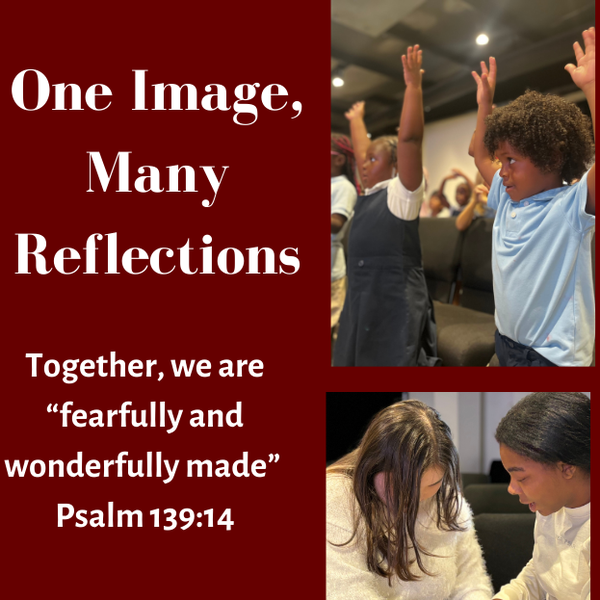
Revelation 7:9
"After this I looked, and there before me was a great multitude that no one could count, from every nation, tribe, people and language, standing before the throne and before the Lamb.”
In Revelation 7, John tells us of a great multitude of people from every tongue, tribe, people, and nation, wearing white robes and worshiping the Lamb of God. This innumerable group came out of the great tribulation and had their tears dried by God Himself.
What an amazing picture of heaven! People from every nation, speakers of every language, skin of every color, all wearing one uniform and singing one song, united in one purpose: to praise and worship the One who saved them, fed them, sheltered them, and gave them living water so they would never thirst again. Can you see it? Can you imagine it? Can you envision the gleaming white robes? Can you hear the thunderous, beautiful voices singing praises to our God and to the Lamb? I am overcome by this imagery!
At chapel on Wednesdays at Christ Classical Academy of Charlotte, I often look around Eastgate Church’s sanctuary and see a reflection of this heaven. I see children from varied backgrounds, who speak different languages, possess diverse learning styles, embody different skin tones, and come from numerous nations, all wearing their CCAC chapel uniforms and singing one song in praise to the Lord. WOW! Can you see it? Can you hear it? Can you feel the power of the moment? Once again, I am overcome!
I’d like to invite you, our CCAC parents, into this reflection of heaven with us on Wednesday mornings at 10:10 a.m. Come join in the singing. Come learn about, worship, and praise the Lord with us. Listen to Dr. Ballard teach. Watch the upper elementary students lead in worship. I can’t promise you’ll see a vision like John the Revelator, but I can promise, when you see a reflection of heaven in the faces of our students and hear the joyful noise they make to the Lord, you won’t regret it.
#OneImageManyReflections
#InHisImage
#KingdomDiversity
#ImageBearer
#ChristClassicalAcademyOfCharlotte
Posted in
Head of School